Why AI Coding Agents Fail on Large Codebases
An AI coding agent that nails a 200-line script will confidently break a 200,000-line monorepo, and it will sound just as certain doing it. The context handed to that agent stays flat text as the codebase around it turns into a graph of calls, imports, and dependencies the agent never gets to see. That gap breaks Claude Code, Cursor, Cline, and Copilot in the same five ways: a context ceiling, grep-and-guess retrieval, stale embeddings, a missing call graph, and blindness past the repository boundary.
The context ceiling
Every agent runs against a token budget, and a large repo blows past it before the real work starts. Point an agent at a 50-file feature and it can read every file involved and hold the whole picture in its working context. Point the same agent at a 200,000-line monorepo and reading "everything relevant" stops being an option, because relevant is exactly what it doesn't know yet. Anthropic's own guide to Claude Code in large codebases admits this directly: ask for every instance of a vague pattern across a billion-line codebase and the agent runs out of context window before the work begins (Claude Code in large codebases). The same guide notes that its hierarchical CLAUDE.md convention, the standard workaround for feeding an agent project context, breaks down on codebases with hundreds of thousands of folders or legacy systems on non-git version control. A bigger window buys headroom. It doesn't decide what the agent reads first, and that decision is where accuracy gets made or lost.
Grep-and-guess retrieval
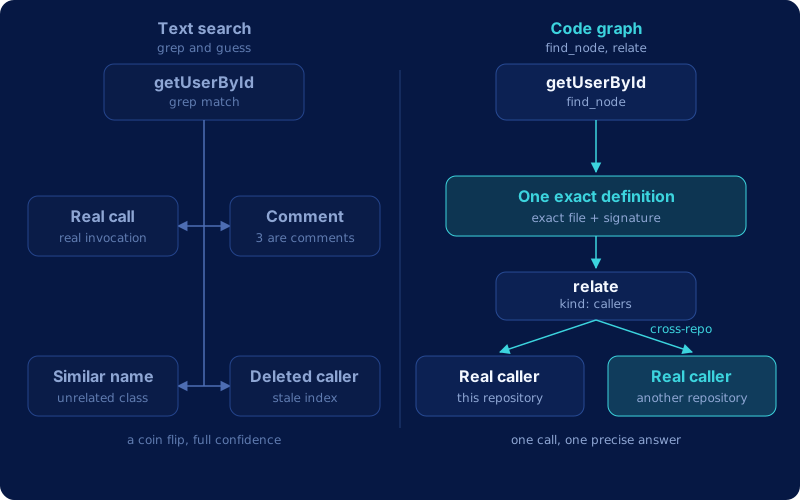
Lacking a map, an agent falls back on the tool every terminal has: text search. Grep finds the string getUserById. It doesn't know that getUserById is called through an interface, that three of its matches are comments, or that a fourth is a similarly-named method on an unrelated class. The same Anthropic guide concedes the failure mode without a language server in the loop: "Claude pattern-matches on text and can land on the wrong symbol." Pattern-matching on text is a reasonable first move for a human skimming a file. As the retrieval strategy behind an autonomous edit, it's a coin flip dressed up as an answer, and the agent hands you the result with full confidence either way.
Embedding staleness
Some agents pair grep with an embedding index: vectors over the codebase, ranked by similarity to the query. That helps with "find code like this" and does nothing for "is this index still true." Every commit changes what's true; most embedding pipelines reindex on a schedule rather than on every commit, so an agent working against yesterday's snapshot can recommend a caller that was deleted an hour ago. Similarity search also answers a different question than the one an agent usually needs answered: "what looks like X" isn't "what depends on X." We go deeper on that distinction in code embeddings vs code graph; the short version is that embeddings rank resemblance, and resemblance is a different signal than connectivity.
No call graph
The question an agent actually needs answered before it edits a shared function is who calls this, and what happens to them. Grep gives you a list of lines that contain the function's name. It does not give you the call graph: which of those lines are real invocations, which are dead code, which route through an interface with a different name at the call site. Without that graph, an agent renaming or changing a shared helper is working blind, and it ships the diff anyway. We cover the mechanics of this failure, and what a real answer looks like, in blast radius analysis.
No cross-repo view
Production systems rarely live in one repository. A backend service, a shared internal library, and two consumers of that library are four repos with one dependency graph running between them, and an agent operating repo-by-repo can't see that graph at all. It changes a function signature in the library repo, runs the library's own tests, and has no way to know a consumer three repos away now fails to build.
This failure is structural, and it is where the current crop of code-context tools stops. A pre-computed index of a single repository, however fast or local, is bounded by that repository: the moment a dependency crosses a git boundary, the edge is missing from the index by construction. The boundary is exactly where the expensive failures live, because the seam between repositories is the one place no single team's tests cover end to end.
The mechanism that closes the seam is the one that already answers the question inside a repository, pointed across a git boundary. Ask what breaks if you change a symbol and the answer arrives as a traversal with file paths attached. On cal.com at commit 176037d, the private helper getHttpError has 2 callers, both in its own file. Its blast radius is 77 symbols across 66 files, reaching the API responders, the tRPC handler factory, and both booking endpoints. Index the consuming repository as well and its call sites join that same answer, where they would otherwise surface in next week's incident review. Grep cannot follow that traversal inside one repository, and a single-repo index cannot follow it out of one, however much it precomputes inside its own walls.
Why bigger context windows don't fix it
The industry's default answer to all of the above has been: wait for a bigger window. It helps at the margins. A ten-million-token window stuffed with unstructured file contents still leaves the agent without a way to know which of those files call which other files; you can widen the pipe without changing what flows through it. What closes the gap is structure: a representation of the codebase where "who calls this" and "what depends on this" are direct lookups. The bigger-model reflex has the same shape and a steeper bill; we run the session arithmetic in Sonnet plus a code graph vs Opus alone.
What structure fixes
This is the case for a code graph over a document pile: index the codebase into nodes (functions, classes, endpoints) and edges (calls, imports, implements, instantiates), and connectivity questions become graph traversals instead of educated guesses. The effect is measured. A Google Research study on enterprise code migration compared standard vector RAG against a hierarchical, graph-aware retrieval approach on real dependency-heavy migration tasks and found API hallucination dropped from 56.4% to 16.2%, and dependency-resolution quality rose from 34.8% to 65.9%, once the graph was in the retrieval loop (Beyond Vector Similarity: Hierarchical Context-Aware Graph RAG vs Standard RAG in Enterprise Code Migration). That's the gap between an agent that invents a plausible-looking API call and one that cites the real one. The same paper reports the trade: graph-aware retrieval scored worse on cyclomatic complexity consistency, 46.7% against standard RAG's 71.6%, and slightly worse on docstring preservation, with CodeBLEU identical at 91% for both. Structure bought correctness on dependencies and cost some tidiness elsewhere.
Symvanta builds this graph directly: it indexes a GitHub repository into nodes and edges, layers semantic search on top with Qdrant embeddings for cases where meaning matters more than exact structure, and serves the whole thing over MCP so any compatible agent, Claude Code, Cursor, or otherwise, gets graph-precise answers.
How this looks over MCP
In practice an agent calls find_node to resolve a symbol to its exact file and signature, relate with kind: callers or kind: dependencies to walk the graph in either direction, find_http_route to jump straight from a path and method to its handler, and ask_codebase when the question is closer to "how does X work" than "where is X." Cross-repo edges mean a relate call against a shared library returns consumers across every indexed repository, current and otherwise. The agent asks the graph a precise question and gets a precise answer in one call.
Known limits
A graph is only as current as the last index, so freshness matters as much as coverage: an agent working on a stale index inherits the same wrong-answer problem it started with, just with more confidence behind it. A graph removes the guessing at the retrieval step; the judgment required to act on what it finds still belongs to the model. Any codebase with heavy runtime-only wiring, plugins loaded by string name, reflection-driven dispatch, has edges a static graph can miss or represent only partially. Pairing structure with a plain account of what it does and doesn't cover is the posture we take through the rest of this series.
We publish this exact analysis for well-known open-source codebases: the architecture pages walk symfony, etcd, prisma, n8n, and others through their real module maps, drawn from the calls edges that run between detected modules.
If you want to see this against a real repository instead of a slide, start a free trial and point it at your own codebase: 7 days, no credit card.